Paying for a migration or doing it yourself: what each costs you
You can do most of a migration yourself. The question is which parts you should not, and those are cheaper to buy than the whole job.

Adam Roe
The short answer
Doing it yourself costs a weekend and a nervous fortnight, and works fine on a small site. Paying for the whole thing costs a day or two of somebody’s rate. The middle option is usually right: do the move yourself, and pay somebody to map the addresses and check the launch, which is where the expensive mistakes live.
On this page
If you are looking for the best website migration service, it is worth knowing before you compare quotes that you probably do not need all of one. Most of a migration is not hard. A specific and small part of it is where the expensive mistakes live, and that part can be bought on its own.
There are three honest routes rather than two, and the middle one is the one almost nobody advertises. If you want the whole thing handled, building and delivering a site end to end covers it. This page is about whether you should.
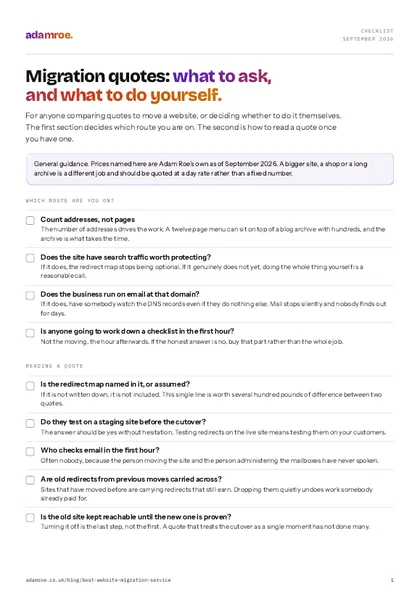 Free checklist, no email needed Migration quotes: what to ask, and what to do yourself. For anyone comparing quotes to move a website, or deciding whether to do it themselves. The first section decides which route you are on. The second is how to read a quote once you have one. Download the checklist
What you can genuinely do yourself
More than the industry tends to admit.
Moving a small site between hosts is mostly following instructions carefully. Moving between hosted platforms is copying your words and pictures into a new editor, which is tedious rather than technical. Rebuilding five pages on a new platform is an afternoon if you have the content.
If your site is a handful of brochure pages, has little or no search traffic yet, and nobody depends on its email, you can do the whole thing yourself over a weekend and be fine. I would rather say that than quote you for something you do not need.
The trouble is that people read “you can do it yourself” as “it is all equally easy”, and it is not.
What you should think twice about doing alone
Three parts, and they are the three that fail quietly.
The redirect map. Every address the old site had, matched to the address it becomes. This is not hard, it is just long, and it is unforgiving: a page that moves without a redirect loses everything it had earned in search. Doing it yourself is entirely possible. Doing it yourself without a list of every address the site actually has is where it goes wrong, because the pages you remember are never all of them.
The domain and email records. Repointing a domain is two minutes of clicking and the one change that can stop your email without any warning at all. If your business runs on email, this is the part to have somebody watch, even if they do nothing else.
The launch checks. Not the moving, the hour afterwards. Whether forms arrive, whether the certificate is valid on the real address, whether Search Console is reconnected, whether anything is quietly returning an error. There is no skill in this list. There is only the discipline to work down it while everyone else is admiring the new design, and that is exactly when nobody does.
What breaks during a migration goes through all of them in detail, including how each one shows itself.
Three routes, not two
Most of a migration is not hard. The small part where the expensive mistakes live can be bought on its own, and that is the middle route.
What each route costs
Doing all of it yourself costs a weekend and a nervous fortnight. That is not nothing, and the real price is not the hours. It is that you are the one refreshing the site at eleven at night wondering whether the thing you cannot quite see is a problem.
Paying for the risky parts starts at £800 here. That buys every old address mapped to a new one, the redirects tested on a staging site rather than on your live one, a launch-day checklist for search, and a call before you go live. You still do the moving, which is the part you can do.
Handing over the whole thing is that plus the move itself at £400 a day, and the move is usually a day or two once the mapping is done. A bigger site gets a day rate quote first rather than a number plucked out of the air.
| You do | Somebody else does | Costs | |
|---|---|---|---|
| All yourself | Everything | Nothing | A weekend, and the worry |
| The middle route | The move | The map, the tests, the checks | From £800 |
| Handed over | Nothing | Everything | From £800, plus £400 a day |
The gap between the second and third rows is smaller than people expect, which is worth knowing when a quote for the whole job lands and looks like a lot.
Where the time actually goes
Not where you would think, and this is the bit that decides whether a quote is honest.
The moving is the short part. On a small site it is hours. What takes the time is listing every address the site currently has, deciding what each one becomes, and testing that the decisions work. On a site with a blog archive, that list is hundreds of lines long and it does not care that you only have twelve pages in your menu.
This is why “how many pages is your site?” is the wrong question and “how many addresses does it have?” is the right one. It is also why a migration is the moment to fix a structure that has been wrong for years: you are paying to touch every address anyway, and the sitemap is an SEO decision rather than a deliverable is the thinking that should happen while it is still free.
Where the time goes
The moving is the short part. What takes the time is listing every address the site has and deciding what each one becomes, and a blog archive has hundreds while the menu shows twelve.
How to compare two quotes
Three questions, and they separate a quote for moving files from a quote for moving a business.
Is the redirect map included, or assumed? If it is not named in the quote, it is not in the quote. This is the single most common gap and it is worth several hundred pounds of difference on its own.
Do you test on a staging site before the cutover? The answer should be yes without hesitation. Testing redirects on the live site means testing them on your customers.
Who checks email in the first hour? A surprising number of quotes have no answer to this, because the person moving the site and the person who administers the mailboxes are often different people who have never spoken.
If you are on the receiving end of a migration rather than commissioning one, the website handover checklist is the list of what should exist before anybody calls it finished.
What I do
- The migration check is £800, and it is deliberately sold on its own. Every old address mapped to a new one, redirects tested on staging, a launch-day checklist for search, and a call before you go live. You do the move.
- The move as well is £400 a day on top, usually one or two once the mapping is done, or a fixed price once the scope can be pinned down.
- Bigger sites get a day rate quote first. A shop, a long archive or years of history is a different job, and pretending otherwise with a fixed number helps nobody.
- You get the redirect map as a file. It is yours, it is checkable, and it is useful again the next time anything moves.
- I will tell you when you do not need me. A five page site with no search traffic moving between hosts is a weekend, and quoting for it would be taking money for reassurance.
Before you ask
Questions people ask.
01 Can I really move a small website myself?
Usually, yes, and plenty of people should. A five page brochure site moving between hosts, or from one hosted platform to another, is genuinely within reach of anyone comfortable following instructions. What makes it hard is not the moving. It is knowing what to check afterwards and in what order, and that part can be bought on its own without buying the whole job.
02 What is the most expensive mistake people make?
Not mapping the old addresses to new ones. Rankings live on addresses, so a page that moves without a redirect goes back to zero, and on a site with any search traffic that is the loss that keeps costing after everything else is fixed. Second is repointing a domain without carrying the email records across, which stops mail silently.
03 How do I compare two migration quotes?
Ask both whether the redirect map is included or assumed, whether they test on a staging site before the cutover, and who checks email in the first hour. Those three answers separate a quote for moving files from a quote for moving a business. Price differences of a few hundred pounds usually come down to exactly that.
04 What if my site is bigger than a few pages?
Then the mapping stops being a spare afternoon and starts being the job, because the number of addresses is what drives the work rather than the number of pages you can see. Anything with a blog archive, a shop or years of history gets a day rate quote first, so nobody is guessing. The check itself starts at £800.
If you have a quote in front of you and are not sure what is missing from it, that is a quick thing to check and it costs nothing to ask.
Send me the quote and your current address and I will tell you what it does not cover, in writing, within two working days.
adamroe.