How much does web hosting cost, and what changes the price?
The word is the same on every quote. What it covers is not, and that is most of the price.

Adam Roe
The short answer
In November 2026, UK web hosting runs from £1 a month for an entry-level shared plan’s first year to £24 a month for managed WordPress, before VAT. Squarespace and Shopify include it in plans from £12 and £19 a month. The price moves with the renewal rate, the billing term, VAT and how much looking after is included.
On this page
Somewhere on the business bank statement there is a payment to a hosting company, and you are fairly sure it is the website. Or there are two quotes for the same site, and the hosting on one is ten times the other. Neither says what it covers.
So how much does web hosting cost, and which of those is right? Quite possibly both. Hosting is one word for very different things, from a few pounds of space on a server to a site somebody updates, backs up and watches every day. In the UK in November 2026 that runs from £1 a month for the first year of an entry-level plan to £24 a month for managed WordPress hosting paid yearly, before VAT, and the gap is mostly about who does the looking after.
I sell website hosting and maintenance for WordPress sites myself, and I say exactly what mine covers near the end. The rest is here so you can read any hosting bill, mine included, and know what it buys. Every outside price below was read on the company’s own page in November 2026.
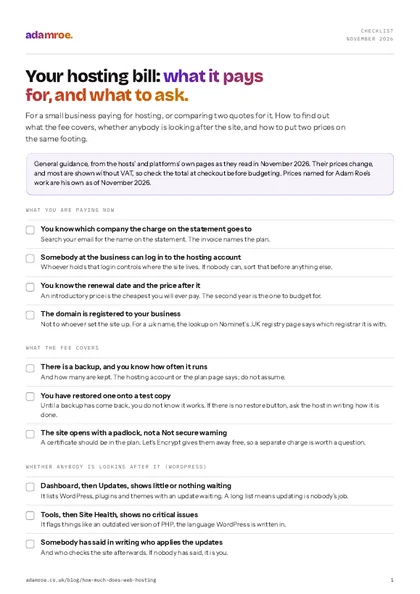 Free checklist, no email needed Your hosting bill: what it pays for, and what to ask. For a small business paying for hosting, or comparing two quotes for it. How to find out what the fee covers, whether anybody is looking after the site, and how to put two prices on the same footing. Download the checklist
What does your hosting fee actually cover?
At its simplest, hosting is rent: space on a computer that is always switched on and connected, where your website lives, so that when somebody types your address the pages arrive.
Every plan covers that much. The host keeps the server running and the server’s own software patched, and every plan in the price table below includes the security certificate, the thing that stops the browser telling visitors your site is “Not secure” (Chrome’s help page, checked November 2026).
After that, plans differ, and the differences are where the price goes.
- Backups. Whether there are any, how often, how far back they go, and whether you can put one back yourself.
- The website software. On WordPress, the core, the theme and every plugin need updating. Some hosts do the core for you. On a basic plan, assume the rest is yours until the host says otherwise.
- Somebody checking afterwards, and putting the site back if an update breaks it. My view: this is the part to ask about first, because it is the part you notice on the day something goes wrong.
- Things bundled in, like email addresses or a free domain for the first year. Useful, but they are not hosting, and they renew on their own terms.
What a hosting fee covers
Every plan keeps a server switched on. After that they differ, and the differences are where the price goes. The right-hand column is about your site rather than the server, and it is the part to ask about before you compare prices.
None of this shows from the front. A site nobody is updating looks exactly like one somebody is, right up until the day it doesn’t. If the right-hand column turns out to be nobody’s job, that is the gap a website care plan is there to fill, and that article goes through what one does each month.
What do the different kinds of hosting cost?
Which bill you should have depends on what the site is built on, not on what you would like to pay.
Which hosting bill is yours
On Squarespace, Wix and Shopify the hosting is part of the plan, so there is no separate bill for it. A WordPress site needs a host, and somebody to keep it updated, as one bill or two. A site built from scratch is hosted the way the project needs.
Here is one real example of each, read at the source in November 2026, with VAT shown the way each page shows it.
| Kind of hosting | Example | Price | VAT |
|---|---|---|---|
| Shared hosting, entry level | IONOS Plus | £1 a month for 12 months, then £9 a month | Not included |
| Managed WordPress hosting | WP Engine Essential, one site | £24 a month, billed yearly: £288 up front | May be added at checkout |
| A website builder | Squarespace Basic | £12 a month paid yearly, or £16 month to month | Not included |
| A builder for a shop | Shopify Basic | £19 a month paid yearly, or £25 month to month | Not stated |
Shared hosting puts your site on a server with others. IONOS’s Plus plan lists 200 GB of storage, two email addresses, a free domain for a year, a certificate, a daily backup and a malware scanner, and says “All prices exclude VAT charged at 20%”.
Managed WordPress hosting is set up only for WordPress, with more of the upkeep done for you. WP Engine’s Essential plan, with the currency set to pounds, covers one site and up to 25,000 visits a month. It lists daily automated backups, kept for at least 30 days, and “WP, PHP, & MySQL managed for you”. The page says taxes may apply at checkout.
A website builder includes the hosting in the plan. Squarespace’s Basic plan includes “Secure hosting” and, paid yearly, a free domain for the first year that then renews at the standard rate. Squarespace’s own help says the prices on its website do not include VAT. Shopify’s Basic plan lists unlimited web hosting and a free SSL certificate, and the page does not say whether VAT is in the price.
Wix hosts its sites too, but its plans page sets prices and currency by location and showed me US dollars, so I have left it out rather than guess at a pound figure.
Why is one hosting quote ten times another?
Two quotes that look miles apart are often pricing different things. Five things move the number.
The first year. An introductory price is the cheapest you will ever pay. Compare the price from the second year on, because that is the one you pay longest.
Paying yearly or monthly. Each plan in the table that offers both is cheaper per month paid yearly: £12 against £16 on Squarespace, £19 against £25 on Shopify. Paid yearly, the whole year goes on the card on day one.
VAT. Most of the pages above show prices without it, so put both quotes on the same footing before you compare them.
The limits. Plans are sized by sites, storage and visits. WP Engine’s one-site plan is for up to 25,000 visits a month, for instance. A plan that looks expensive may be sized for a busier site than yours.
Who does the work. This is the big one. A few pounds a month is the rent. A quote at ten times that should include somebody updating the site, checking it afterwards and putting it back when an update breaks it. If it does not say so in writing, ask.
Two quotes, side by side
Before deciding one quote is expensive, put the same six questions to both. The first three are about how the price is shown. The last three are about what you are actually getting for it.
Do you pay extra for the domain and the certificate?
The domain is your address, and it is a separate thing from hosting, even when one company sells you both. It renews on its own date.
A .co.uk comes from Nominet, the .uk registry, but you buy it through a registrar: Nominet’s own site sends you to a list of registrars to buy from. Its registrar pages put the wholesale price of a .uk name at £3.90 a year, the same as a .co.uk, and Nominet says “Retail registrars set pricing for registrants” (all checked November 2026). So the price varies by registrar. IONOS lists a .co.uk at £1 for the first year, marked down from £10, excluding VAT.
Whichever registrar it is, the thing worth two minutes is whose name the domain is registered to. It should be your business, not whoever set the site up. If it is somebody else’s, or the hosting account is, handing over a WordPress website goes through moving each one into your name.
The certificate should cost you nothing extra. Let’s Encrypt describes itself as “a free, automated, and open Certificate Authority”, and every plan in the table includes a certificate. If a quote charges for one separately on a small business site, ask what it gets you that the free one would not.
How do you check what your hosting bill pays for?
This is twenty minutes with your logins, and you do not need to be technical for any of it.
Find the company and the plan
Search your email for the company name on the bank statement. The invoice names the plan. Then log in to the hosting account and find the billing or contracts page, which shows the renewal date and what the next payment will be.
How to check it: you can say the plan’s name, the date it renews and what it will cost then. If nobody at the business can log in, sort that first, because whoever holds that login controls where the site lives.
Find out what the backups are
In the hosting account, find the backups: how often they run, how many are kept, and whether there is a button to restore one. If there is no button, ask the host in writing how you would get one back and how long it would take.
How to check it: restore one onto a test copy and click through it. How to do that safely is part of how to secure a WordPress site, because until you have restored one, you do not know it works.
See whether anybody is updating WordPress
Log in to WordPress and open Dashboard, then Updates. It lists WordPress itself, plus every plugin and theme with an update waiting (WordPress’s own guide, checked November 2026). Then open Tools, then Site Health, which flags problems such as the site “running an outdated version of PHP”, the language WordPress is written in (Site Health screen, checked November 2026).
How to check it: the updates list is empty, or close to it, and Site Health shows no critical issues. A long list of waiting updates means updating is nobody’s job, and nothing on the front of the site will tell you.
Check whose name the domain is in
Nominet’s .UK registry page has a lookup that tells you which registrar a .uk name is with (checked November 2026). Log in there and read the registrant details.
How to check it: the registrant is your business, and the login uses an email address the business controls. Miss it and the address on your van is in somebody else’s name.
What my hosting fee covers
Everything above is how to read anybody’s bill. This is mine, as my WordPress hosting plan sets it out.
- £50 a month, for WordPress sites, with no VAT charged. That covers the hosting and the security certificate, a firewall in front of the site, malware scanning in real time with anything found patched, a backup every day made by the host, uptime and security monitoring, updates every month checked afterwards, the site put back if an update breaks it, and a note each month of what was done.
- The domain stays registered in your name. Renewing it stays with you, outside the £50, and so do email inboxes and any premium plugin licences.
- Changes are £75 an hour when you ask for them, or Hosting and Manage at £350 a month for three hours of changes and a reply within 12 working hours. Hosting and Grow is £725 a month, with eight hours of changes.
- Three months minimum, then a month’s notice. If you leave, you get a full backup of the site and help moving it, free.
- A live WordPress site I did not build starts with a take-on check, £200, half a day, so nothing moves blind. You get the findings in writing, then a price for the move.
- Not every site needs it. Squarespace, Wix and Shopify host themselves, so there is no hosting to buy from me for those. A custom build or a web app is hosted the way it needs to be and priced with the project, never from a monthly plan.
Before you ask
Questions people ask.
01 Is free web hosting good enough for a business?
For trying an idea out, yes. For a business, it usually costs you your own address. Wix, for example, lets you make a site for free, but it sits at an address like username.wixsite.com/sitename, and connecting your own domain and removing the Wix branding needs a Premium plan (Wix’s plans page, checked November 2026). If customers are going to find you under your own name, the cheapest paid plan is the real starting point.
02 Are hosting prices shown with or without VAT?
Usually without, so check before you compare two of them. IONOS says all its prices exclude VAT at 20%, Squarespace says the prices on its website do not include VAT, and WP Engine says taxes may be added at checkout (all checked November 2026). A plan at £9 a month is £10.80 once VAT is on. Shopify’s pricing page does not say either way, so read the total at checkout before you decide.
03 Is web hosting a one-off cost?
No. Hosting is paid for as long as the site is live, monthly or yearly, and the domain renews separately on its own date. The one-off cost is building the site. On Squarespace, Wix and Shopify the platform’s plan is the running cost, paid to them. On WordPress it is the hosting plus whoever keeps the site updated, as one bill or two. When you compare build quotes, ask what the site will cost a month from launch as well.
04 Why does hosting from a web developer cost more than buying it myself?
Because most of what you are paying for is the looking after, not the server. My hosting is £50 a month for WordPress sites, with no VAT charged, and covers the hosting and certificate, a backup every day, monitoring, updates every month checked afterwards, and the site put back if an update breaks it. If you would rather do the updates and watch the backups yourself, a cheap plan is a perfectly sensible choice.
If there is a hosting charge on your statement you cannot quite put a name to, don’t worry. It is a twenty-minute job to find out what it pays for, and we will get there.
Tell me what your site runs on and who hosts it now, and I will tell you whether it is being looked after or just kept switched on.
adamroe.