An IT company or a web developer: who to ring in Milton Keynes
Both are good at their own half. Almost every awkward phone call happens in the four things that sit between them.

Adam Roe
The short answer
An IT company looks after your computers, your network and usually your email accounts. A web developer looks after the website. The confusion sits in four things that belong to neither by default: the domain, the DNS records, the hosting and the mailboxes. Decide who holds those, write it down, and the awkward calls stop.
On this page
If you are looking up an IT company in Milton Keynes because the website has gone wrong, or ringing a web developer because the email has stopped, you have hit the most common confusion in small business technology. Both suppliers are good at their own half. Almost nobody explains where the line between them sits.
I am the web developer half of this, so take the usual pinch of salt, though I would rather send you to the right person than bill you for an hour of working out it was not me. The short version of what I do is on the page for a web developer in Milton Keynes. This is the longer version of who to ring for what.
Nothing here is a criticism of IT firms. A good one is worth its fee several times over, and a firm that says “that is not our area” is being a better supplier than one that says yes to everything.
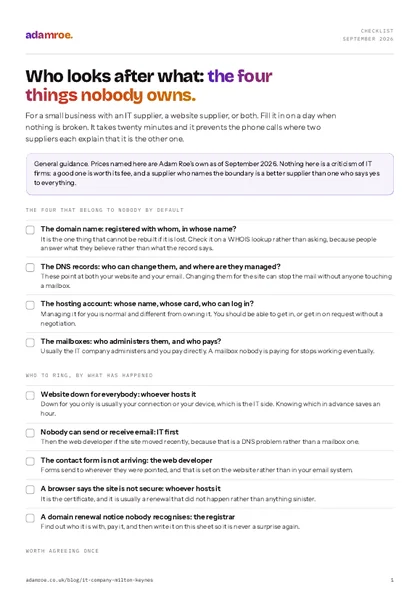 Free checklist, no email needed Who looks after what: the four things nobody owns. For a small business with an IT supplier, a website supplier, or both. Fill it in on a day when nothing is broken. It takes twenty minutes and it prevents the phone calls where two suppliers each explain that it is the other one. Download the checklist
What an IT company looks after
Broadly, the things in your building and the accounts your staff sign into.
Laptops and desktops, whether they work and whether they are backed up. The network, the wifi, the router. Printers, on a bad day. Antivirus, device security and the policies that go with them. Microsoft 365 or Google Workspace accounts: creating them, resetting passwords, adding a person when somebody joins.
That last one matters for this article, because it is where the overlap starts. An IT company very often administers your email, which makes people assume email belongs with them entirely. It mostly does, right up until the domain moves.
What a web developer looks after
The website, and the things that decide whether it works and whether it is found.
The pages themselves, the design, the content. The platform it runs on and the updates it needs. Forms, and whether they actually arrive. Speed, structure, and whether Google can read it properly. On a WordPress site, usually the hosting too.
What a web developer typically does not do is fix your laptop, and I want to be plain about that rather than vague. If the machine in front of you is slow, that is not me.
Two suppliers, and the middle
The two outer columns are rarely argued about. The middle one has no owner unless somebody names one, which is where almost every awkward phone call happens.
The four things in the middle
Here is the actual answer to the question in the title. These four belong to nobody by default, and every uncomfortable conversation happens in them.
The domain name. Your address. It should be registered in your name, in an account you can log into, whoever manages it day to day. It is the one thing that cannot be rebuilt if it is lost, and the most common problem I find is that it is sitting in a supplier’s account with the best of intentions.
The DNS records. The instructions that say where your website lives and where your email goes. Both, in the same place. This is the single technical fact that explains almost every crossed wire between the two suppliers: change the records for the website and you can stop the email without touching a single mailbox. It is also why a web developer needs to talk to whoever runs your email before a site moves, rather than after.
The hosting account. Whose name it is in, whose card pays it, and who can log in when it needs something. On a WordPress site I host, that is mine to run and yours to leave with whenever you want.
The mailboxes. Usually the IT company’s to administer, and usually paid for by you directly. Worth knowing which, because a mailbox nobody is paying for stops working eventually.
Write those four down with a name against each. That single page of paper prevents more trouble than any contract.
So who do I ring?
By symptom, which is how the problem actually arrives.
| What has happened | Ring |
|---|---|
| The website is down for everybody | Whoever hosts it |
| The website is down only for you | IT, it is usually your connection |
| The website looks wrong after an update | The web developer |
| Nobody can send or receive email | IT first, then the developer if the site moved recently |
| One person cannot get into their email | IT |
| The contact form is not arriving | The web developer |
| A browser says the site is not secure | Whoever hosts it, it is the certificate |
| You want a new page, or the prices changed | The web developer |
| A new starter needs an email address | IT |
| The domain renewal has appeared and nobody knows what it is | Whoever the domain is registered with, and then write it down |
The one worth reading twice is email after a site move. If the website changed recently and email stopped, it is almost never a coincidence, and the fix is in the DNS records rather than in the mailboxes.
The one page of paper
Four things belong to nobody by default. Write them down with a name against each, and that single page of paper prevents more trouble than any contract.
Do you need both?
Often not at the same time, and it depends on which way your business leans.
A business with staff, laptops and a network needs IT support and may need a website person a few hours a month. A business that is mostly a website, with two people and their own phones, needs the reverse. Plenty of small businesses in Milton Keynes have one and not the other for years, quite happily.
What causes trouble is not having one of them. It is having neither, and assuming the other covers it. That is how a site goes eighteen months without an update, or how nobody notices the domain renewal until the email stops on a Tuesday.
If you are about to hire either, the questions local businesses ask first covers what a website quote should name, and the website handover checklist is the list of what you should be holding whoever built it.
Where I come in
I do the website half, and I will tell you plainly when something is not mine.
- Websites built, fixed or moved, at £400 a day or a fixed price where the work can be pinned down.
- Hosting a WordPress site is £50 a month, with updates, daily backups and the certificate in it. On Squarespace, Wix or Shopify the platform hosts itself and there is no hosting charge from me.
- Changes afterwards are £75 an hour, or a monthly plan if there will be enough of them.
- Business email set up on your domain is £200 as part of a build, on your own Google Workspace or Microsoft 365 account, so your IT company can administer it afterwards without going through me.
- When it is an IT problem, I will say so rather than bill you for finding out. Email that has stopped is usually the mail provider rather than the site, and I would rather tell you which it is in ten minutes than take the hour.
- Local enough to come in. I live and work in Milton Keynes and will come to you for a kick-off or the awkward meeting, anywhere in MK and the towns around it, at no extra cost.
Before you ask
Questions people ask.
01 Our IT company says the website is not their job. Are they right?
Usually yes, and it is not them being unhelpful. Supporting laptops, networks and accounts is a different discipline from building and maintaining a website, and a firm that is honest about the boundary is a better supplier than one that says yes to everything. What is fair to ask them for is the technical detail: who the domain is registered with, what the current DNS records are, and who pays for what.
02 Who should hold the domain, them or us?
You should, always, in an account in your own name that you can log into. It is completely normal for an IT company or a developer to manage it for you, and that is different from owning it. Check it on a WHOIS lookup rather than asking, because the answer people give is often the answer they believe rather than the one the record shows.
03 The website is down. Who do I ring first?
Whoever hosts it, which is not always obvious and is worth writing down before you need it. If the site is down for everyone it is hosting or the domain. If it is down only for you, it is usually your connection or your device, which is the IT company’s half. Ringing the wrong one first costs you an hour, and knowing which is which in advance costs you nothing.
04 Do we need both, for a five person business?
Often not at the same time. Plenty of small businesses have IT support on call and a website that needs somebody a few hours a month, or the reverse. What matters is that both jobs have a name against them rather than being assumed. Website work with me is £75 an hour or a monthly plan, and hosting a WordPress site is £50 a month.
If you are not sure which of the two your problem is, describing it in a sentence is usually enough for me to tell you, and that costs nothing.
Tell me what has stopped working and I will point you at the right person, even when the right person is not me.
adamroe.