IR35 and your web developer: what actually decides it
The contract matters less than what actually happens, so it helps to agree how we will work first.

Adam Roe
The short answer
Three tests decide it: whether someone else could genuinely do the work, whether you control how and when it is done, and whether either side is obliged to carry on when the work finishes. What the contract says matters less than what happens day to day. For a medium or large client, the decision is theirs to make.
On this page
IR35 is one of those subjects where everybody tenses up a bit when a web developer comes on board, so let me start with the part that matters most to both of us.
I’m happy to work outside IR35 where the working practices genuinely support it, and I’ll always be straight with you if they don’t.
If you’re a medium or large business, the status decision is yours to make, and the tax risk sits on your side of the arrangement rather than mine. If you’re a small business in the private sector, GOV.UK puts it the other way round and the decision stays with my company. Either way it’s worth us talking it through together before anything is signed. It’s a much easier conversation at the start than one with your accountant eighteen months later. If you’re bringing me in as a freelance web developer, by the day or the job, it’s nice to have it settled early.
What follows is how I approach it, in plain English. It’s general information rather than advice, and for anything with money attached it’s always worth speaking to someone qualified.
The rules themselves are HMRC’s, not mine. The off-payroll working guidance on GOV.UK says who is responsible for deciding, and Check Employment Status for Tax, HMRC’s own tool, gives you its view of an engagement. HMRC says it will stand by that result as long as the information you give it is accurate and in line with its guidance. Both checked 17 September 2026.
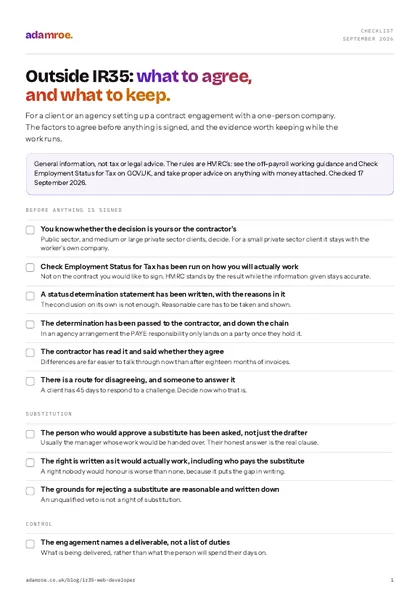 Free checklist, no email needed Outside IR35: what to agree, and what to keep. For a client or an agency setting up a contract engagement with a one-person company. The factors to agree before anything is signed, and the evidence worth keeping while the work runs. Download the checklist
The three things that decide it
The legislation is complicated. The good news is that the tests that actually get applied are much simpler, and they haven’t changed much in decades.
There are more than three, to be straight about it. HMRC’s employment status manual lists a long set of factors, including who provides the equipment, who carries the financial risk, how someone is paid and how far they are treated as part of the organisation (ESM0500 onwards, checked 17 September 2026). These three are the ones most arrangements turn on, and the ones we can agree together in advance.
Substitution
Can I send somebody else to do the work?
If the contract says yes, but everyone involved knows the answer is really no, the clause doesn’t help. It can even be worse than having no clause at all, because it puts something in writing that doesn’t match what happens.
A genuine right of substitution means: I could propose a suitably qualified person, you could reject them for a good reason, and the arrangement would survive. In practice it’s rarely exercised. What matters is whether it’s real.
How to check it: ask the person who would actually have to approve a substitute, rather than the person who drafted the contract. Usually that’s the manager whose work would be handed over, and their honest answer takes about ten seconds to get. If it’s no, the clause is describing something the business wouldn’t do.
Worth being upfront about for a one-person business: substitution is the hardest of the three tests for a solo contractor, because the whole point is that you get me. That’s a real tension, and it’s better said out loud. It’s also why it’s worth getting the other two tests clearly right.
Control
Am I told what to deliver, or how and when to do it?
Two lists, and the useful question is which of them our actual week would look like.
Pointing one way: a defined outcome, my own working pattern, my own equipment, deciding my own method, being able to work on other clients concurrently.
Pointing the other: fixed hours, a seat in your daily stand-up as a team member rather than a supplier, line management by one of your staff, being moved onto whatever needs doing this week, an induction that treats me as a new joiner.
The stand-up is worth a closer look, because it’s such an everyday part of how teams work. Attending a stand-up to coordinate is normal supplier behaviour. Being assigned tickets in it like an employee is control. The difference is real, it’s visible to an inspector, and it’s easy to get right if we think about it together in advance.
How to check it: read the induction pack and a fortnight of calendar invitations rather than the contract. HMRC’s manual breaks control into four questions, what is done, where it’s done, when it’s done and how it’s done, so go through the invitations asking which of the four somebody else is answering for me.
This is the one that drifts without anybody deciding to change anything. An engagement that started as a defined piece of work becomes “whatever needs doing this week”, and by then the evidence of control is a year of calendar entries, which is much harder to argue with than a clause.
Mutuality of obligation
Are you obliged to give me more work when this piece finishes, and am I obliged to accept it?
This is the one that can shift quietly over a long engagement. A contract that rolls indefinitely, with no defined end and no defined deliverable, starts to look like employment regardless of what the paperwork says, because in practice there’s an ongoing obligation on both sides.
How to check it: look at the current contract for two things, a deliverable and an end date. If neither is there, or the end date has been pushed twice without a new scope being written, that’s the drift. Then look at what happened the last time there was a gap in the work, because that’s the question the test is really asking.
What this one costs is the whole engagement rather than a clause. A determination made honestly at the start can stop being true eighteen months later without anyone noticing, which is why it’s worth re-reading at each renewal rather than once.
The fix is simple: engagements with a defined scope and a defined end, re-contracted when there’s more work rather than extended by default. That’s also just good project management, which is a nice bonus.
Three tests, both ways
None of these are settled by the wording. They are settled by what actually happens in the week.
Why the contract matters less than people think
This is the bit that surprises people. None of the three are settled by the wording. They’re settled by what actually happens day to day.
So a contract that doesn’t match the working practices can be worse than a vague one, because it puts the gap in writing. If a substitution clause was never really going to be used, an inspector will reasonably wonder about the rest of the arrangement too, not just that clause.
So the useful order is: agree how we’ll actually work, then write a contract describing that. Not: sign a contract with the right words in it and hope the working practices follow.
Two orders, one of them worse
A contract that does not match the working practices puts the gap in writing, which is why a tidy one can be worse than a vague one.
What I’ll do, and what I won’t
Three things you can hold me to.
I’ll review your assessment before anything is signed. It’s much easier to talk through any differences at that stage. There is a formal route afterwards, where a worker or the deemed employer disagrees with a determination and the client has 45 days to answer (off-payroll working for clients, checked 17 September 2026), but I’d much rather neither of us ever needed it.
I’ll work inside IR35 where that’s the honest answer. Some engagements genuinely are. An open-ended role embedded in your team, with day-to-day direction, will usually be inside, and it’s better for both of us to say so. The rate conversation is a bit different then, and that’s completely fine.
I won’t help put together a determination neither of us believes. The tax risk usually sits on your side, and I’d much rather the people I work with were in a safe, settled position.
Making it easy for the agency
If you’re an agency placing me with your own client, the determination question sits with whoever the end client is, and the arrangement has more layers than a direct engagement. Three things make it straightforward, and none of them is hard once somebody actually asks the question:
Decide the model first. Behind the scenes, fronted under your brand, or named subcontractor, the three white-label models, because each one implies a different working pattern, and the working pattern is what the tests look at.
Know which of us is the deemed employer. The determination is the end client’s, but the PAYE responsibility lands on the qualifying party in the chain that pays my company, once the determination has been passed down to them, and on the client if there is no such party (deemed employer responsibilities, checked 17 September 2026). In a three-party arrangement that is usually the agency, so it’s worth knowing before the first invoice rather than after it.
Who decides, and who pays
Two different questions, and both are easiest to answer before the first invoice rather than after it.
Scope to a deliverable, not to a period. “Deliver the migration” survives scrutiny far better than “three days a week until further notice”, and it makes for a better project regardless. A project bought by the week is also where the date stops moving while the scope keeps growing, which is a problem long before it is a tax one.
Where it’s genuinely uncertain
Status determination can be genuinely uncertain at the edges. Some engagements aren’t clearly one thing or the other, and the case law reflects that.
What we can do is make the arrangement clearly one thing rather than a bit of both: a defined deliverable, a defined end, genuine control over method, and a contract that describes what actually happens. That’s simply an accurate description of buying a service rather than employing somebody, which is what a well set up contract engagement is.
It’s a bit like the difference between hiring a builder for an extension and taking someone on as staff. You agree with the builder what’s being built and when it’s due, and they decide how to build it.
Get that right together and the paperwork becomes straightforward. If the day to day doesn’t match, the wording on its own won’t fix it.
How I set an engagement up
None of this is a special IR35 process. It’s how all four of the things I do are scoped anyway, which is most of the reason the conversation is usually short.
- Everything is scoped to a deliverable with an end on it. A written scope arrives within 2 working days of the scope call, saying what I’ll do, in what order, what it costs and when it lands. When there’s more work afterwards, it gets its own scope rather than an extension.
- The day rate is £400. Fixed price where the job can be pinned down, by the day where it can’t, and the price is in the written scope before anything starts. If inside IR35 is the honest answer for a piece of work, the rate conversation is a different one, and we have it openly.
- The first thing I’d do is read your determination and the draft contract next to how we’ve actually agreed to work, and tell you where the three differ. That’s a conversation, not an invoice.
- My own equipment, my own hours, remote across the UK, coming in for kick-offs and workshops where being in the room genuinely helps. Worth writing into the scope rather than leaving it as something everyone assumes.
Before you ask
Questions people ask.
01 Who decides whether a contract is inside or outside IR35?
The client does, if they are a public sector body or a medium or large private sector business. They have to give a status determination statement with the reasons for it, and take reasonable care making it. If the client is a small private sector business, GOV.UK puts it the other way round and the decision stays with my own company.
02 Does a substitution clause on its own put a contract outside IR35?
No. What counts is whether the right is real, not whether it is written down. If everybody involved knows a substitute would never be accepted, the clause can make things look worse rather than better, because the paperwork and the practice now disagree in writing. It is also only one of the factors, alongside control and whether either side is obliged to carry on.
03 Does joining your daily stand-up make it inside IR35?
No, not on its own. Coming to a stand-up to coordinate with the people you are delivering alongside is ordinary supplier behaviour. Being handed tickets in it, the way an employee is, points at control, which HMRC’s manual looks at across what is done, where, when and how. It is an easy one to get right if we agree it before the first week.
04 Should we use HMRC’s CEST tool?
Yes, it is a sensible place to start, and HMRC says it will stand by the result as long as the information given stays accurate and follows its guidance. Answer it about how we will actually work rather than about the contract you would like to sign. If the answer comes back unclear, that usually means the working practices are unclear, which is the real thing to fix.
05 Do you work outside IR35 on a website build?
Often, yes, because a build is naturally a deliverable with an end on it. A written scope arrives within 2 working days of the scope call, saying what I will do, in what order, what it costs and when it lands, which is the shape the three tests are looking for. The day rate is £400 either way, and if inside is the honest answer for a piece of work, I will say so.
I’m always happy to look over your assessment before anything is signed, and happy to work inside IR35 where that’s the honest answer. We’ll work it out together.
Tell me about the engagement and I’ll reply within 12 working hours with how I read it. It still isn’t legal advice, so do run it past someone qualified too. Thanks so much for reading, really appreciate it.
adamroe.